Hair Growth: What I wish I knew before I started losing my hair
For years, I had bald spots on my scalp and had no idea what was causing them. I was ashamed. I tied my hair up every single day and never really looked at it, let alone took care of it. I just assumed it was something I had to live with. It wasn't. And once I understood why my hair was struggling, everything changed.
The questions I wanted answered
How does hair actually grow?
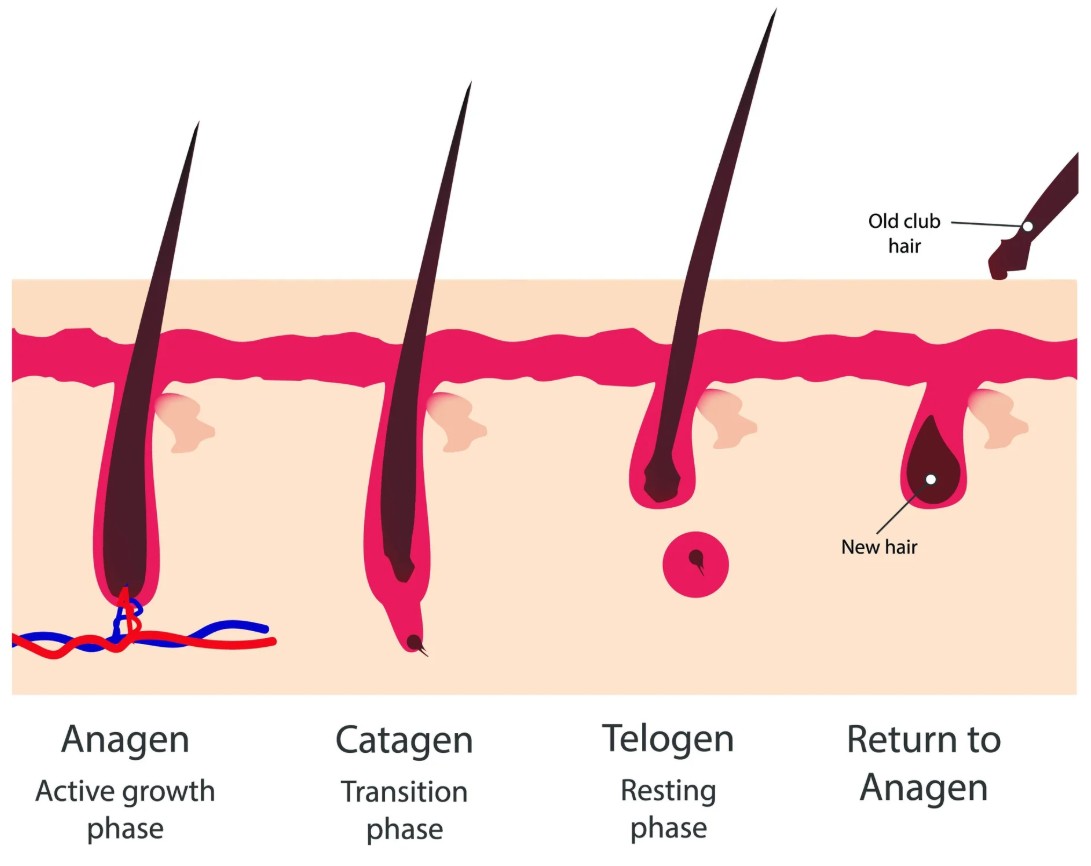
Your hair grows from a hair follicle, a small structure deep inside your skin. Every follicle goes through three phases:
Anagen: the active growth phase, lasting 2 to 7 years
Catagen: a transitional phase of about 2 weeks
Telogen: a resting phase of ~3 months, after which the hair falls out and the cycle restarts
Right now, about 85–90% of your hair is in the growth phase. What that means: you have far more influence over your hair than you think, but you have to actually nourish those follicles.
Source: Buffoli et al., International Journal of Dermatology, 2014
What does your hair need to grow?
Your hair is made up of roughly 95% keratin, a protein. If you're not eating enough protein, your body simply doesn't have the raw material for hair growth.
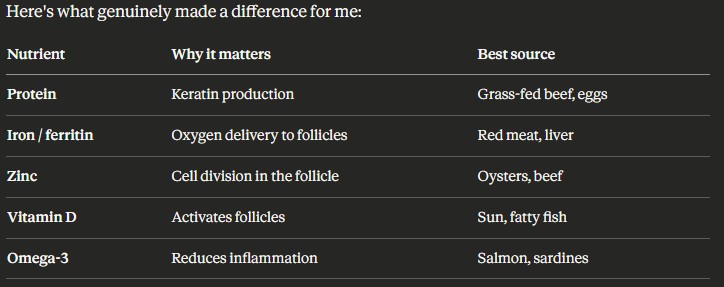
I wasn't eating enough protein. I barely ate red meat. My iron levels were "normal" according to my doctor, but for optimal hair growth, your ferritin needs to be above ~70 µg/L. Most doctors only treat below 12. That gap is enormous, and most people never find out.
Source: Almohanna et al., Dermatology and Therapy, 2019
How fast does hair actually grow?
On average, about 1.25 cm per month, that's it. There is no proven way to significantly speed this up in a healthy person. What you can do is prevent hair from breaking or falling out. That way you retain more length and it looks like it's growing faster.
That's exactly what my routine focuses on.
Why am I losing hair?
This is where I genuinely think differently from the mainstream. Everyone blames genetics. But genetics is only one piece of the puzzle.
The real causes I found through my research:
DHT: the hormone that shrinks follicles in pattern hair loss. Yes, there's a genetic component. But your lifestyle influences your hormone balance far more than most people realize.
Low ferritin: one of the most underestimated causes of hair loss, especially in women. Your doctor says your levels are fine. Your hair disagrees.
Chronic stress: cortisol pushes follicles into the resting phase en masse. You see the result 2 to 4 months later, by which point you've completely forgotten what caused it.
Eating too little: your body treats hair as non-essential. When there's a calorie deficit, energy goes to your organs first. Crash diets are a direct attack on hair growth.
Thyroid issues: both an underactive and overactive thyroid disrupts your entire hair cycle.
I had never truly nourished my hair. That was the real cause, not my genes.
Source: Harrison & Bergfeld, Cleveland Clinic Journal of Medicine, 2009
Do topical products actually help hair grow faster?
Honest answer: no. The hair shaft you can see is dead tissue. You cannot feed dead tissue with a serum or oil.
What does have real evidence behind it:
Minoxidil: the only topical treatment with strong scientific backing. Doesn't work for everyone.
Rosemary oil: one study compared it directly to 2% minoxidil and found comparable results. Promising, but still early to draw hard conclusions.
Scalp massage: improves blood circulation, with a small but real effect on follicle stimulation.
Source: Panahi et al., Skinmed, 2015
Does shampoo damage your hair?
It depends entirely on what's in it.
Most cheap shampoos contain sulfates (SLS/SLES), aggressive cleansers that strip the protective layer from your hair. Your scalp compensates by producing more sebum. Your hair gets greasy faster. You wash more often. The cycle repeats itself.
On top of that, most conditioners contain silicones that fake a smooth layer over damaged hair. Beautiful on the outside, damaged underneath.
My conclusion: most people wash too often, with products that are actively disrupting their scalp.
Why do you even need shampoo?
Biologically speaking, shampoo isn't strictly necessary, your scalp naturally produces sebum to protect your hair. But in practice, a good shampoo helps:
Remove excess sebum and dirt
Keep the scalp microbiome in balance
Deal with odor, especially when you work out and sweat
It's not about how often you wash. It's about what you use, and whether it respects or disrupts your scalp.
My routine | what actually changed everything
I'm not going to tell you I found some miracle product. That's not what happened.
What truly changed was my entire lifestyle. I started eating significantly more protein and specifically grass-fed beef. Not supermarket meat, but real quality, grass-fed and finished. High in iron, omega-3, zinc, everything your hair actually needs is in there.
My washing routine changed completely too. I stopped washing my hair every day. First twice a week, then down to once a week. Because I train regularly and sweat, I rinse with water every two days, no shampoo. That's enough to stay fresh without disrupting my scalp.
And the shampoo I do use? It has to respect my scalp, not strip it.
The shampoo I use and recommend
This post contains affiliate links. If you purchase through my link, I may earn a small commission at no extra cost to you.
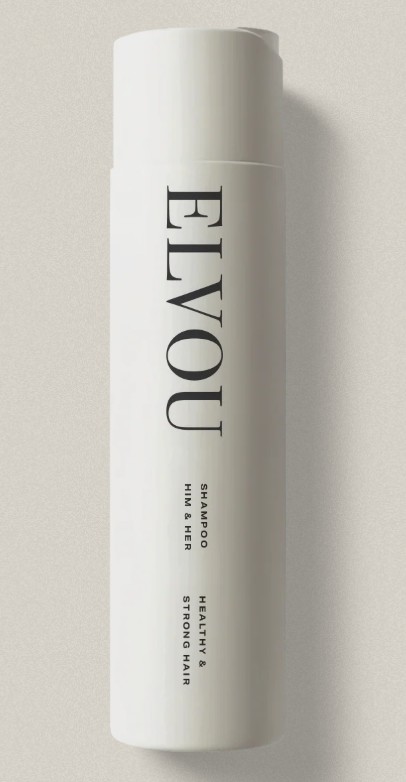
I use the Elvou Shampoo and that's not a random choice.
No SLS. No SLES. No silicones. No synthetic fragrances. No microplastics.
What it does contain: plant-based cleansers, rosemary leaf extract, the ingredient with the most promising research for follicle support, chamomile, green tea extract, and glycerin.
It lathers less than what you're used to. That's the whole point. Lather is a psychological trick created by sulfates. Your hair gets clean without your scalp being thrown off balance.
What people say after switching: "My hair feels amazing, no more itchy scalp." And after a few weeks of adjustment: "The best shampoo I've used in years."
→ Check the Elvou Shampoo here
My final thoughts
Hair growth is not something you fix from the outside with a serum or oil. It starts from within, with what you eat, how you sleep, how much stress you carry, and whether you let your scalp breathe or constantly disrupt it.
I had bald spots. I was ashamed of them. And I was told it was genetic, that there was nothing I could do.
That wasn't true. Or at the very least, it was incomplete.
More protein. Grass-fed meat. Washing less. A shampoo without the junk ingredients. That's my routine. Simple, backed by research, and it works.
Most recent blogs
What I'm currently learning.