5 questions I had before putting a Miswak in my mouth
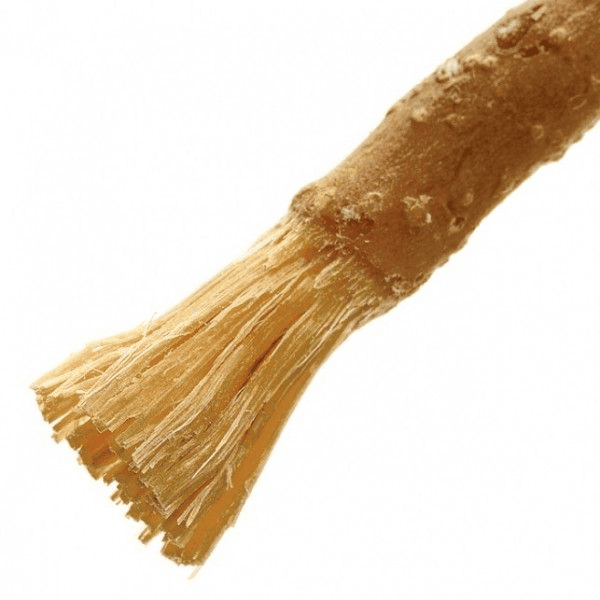
Miswak
Brushing your teeth with a stick. No plastic, no foaming paste, no SLS stripping your oral mucosa while you convince yourself you're doing something good.
Miswak has existed for thousands of years, longer than Colgate, longer than the minty freshness we've been sold as the standard. It sat at the bottom of my list until I realized my "clean" routine wasn't actually that clean.
The first time I used one, it smelled like earth and mustard. I chewed the tip and thought: this is bizarre. Three days later the taste felt normal. A week in, my teeth seemed less sensitive. Two weeks later, my dentist said, without me mentioning it, that my gums looked good.
Here are the questions I was curious about.
What compounds are actually released and what do they do?
Miswak is chemically rich by nature.
When you chew, it releases silica, vitamin C, and alkaloids, including salvadorine and benzyl isothiocyanate. That last compound is also responsible for the sharp, mustard-like taste.
Salvadorine directly inhibits bacterial growth and stimulates gum tissue. Silica polishes enamel mechanically, without harsh chemistry. And vitamin C supports the repair of gingival tissue.
Supported by: Al-Lafi & Ababneh — A review on miswak and its effect on various aspects of oral health, PMC 2013 and Haque & Alsareii — A review of the therapeutic effects of using miswak on oral health, PMC 2015
Does it kill the good bacteria in my mouth too?
This is the crucial difference from chemical mouthwash.
Mouthwash with alcohol or chlorhexidine is like dropping a bomb, it kills everything, including the beneficial species your oral ecosystem actually needs.
Miswak works selectively. Research shows it is specifically effective against Streptococcus mutans, the bacteria responsible for tooth decay, while leaving healthy flora largely intact. The reduction in S. mutans was found to be significantly greater with miswak use than with conventional toothbrushing.
Your oral microbiome matters as much as your gut microbiome. You want to protect it, not reset it every single day.
Supported by: Sofrata et al. — Strong antibacterial effect of miswak against oral microorganisms, Journal of Periodontology 2008 and Sagar et al. — In vitro evaluation of antimicrobial effect of miswak against common oral pathogens, PMC 2014
How do I know if a miswak is fresh enough?
This is the question most people skip and it determines everything.
The main active compound in miswak, benzyl isothiocyanate, is volatile by nature. Scientific research has shown that more than 90% of this compound is lost when the wood is dried or exposed to heat. A odorless, bone-dry stick is literally an empty shell.
A good miswak is flexible, not brittle. The bark is even, with no holes or unusual discoloration. And it smells, that combination of earth and subtle sharpness means the essential compounds are still intact.
The best miswaks come vacuum-sealed from, the mineral-rich soil there produces the right active concentrations in the wood. Ideal thickness: roughly the same as your pinky finger.
Supported by: Alali et al. — Optimization of benzyl isothiocyanate extraction in Salvadora persica roots, PMC 2019 and Sofrata et al. — Benzyl isothiocyanate, a major component from Salvadora persica, PMC 2011
Can miswak damage my gums?
Yes, if you use the wrong technique.
A dried-out miswak produces sharp fibers instead of soft bristles. Research on gingival recession in miswak users consistently shows that damage is almost always linked to excessive use, too much pressure, or a stick that has dried out, not to miswak itself.
Always chew the tip first until it's genuinely loose and soft. Use small, circular motions along the gum line. Not the hard scrubbing motion you might be used to from an electric toothbrush.
Softness and intention. That is the technique.
Supported by: Goh et al. — The prevalence of gingival recession among miswak users: a systematic review, ScienceDirect 2025 and Al-Otaibi — Miswak in oral cavity: An update, PMC 2015
Does it matter which tree it comes from?
Absolutely.
The gold standard is Salvadora Persica, also known as the Arak tree. The specific combination of benzyl isothiocyanate, salvadorine, and mineral compounds is unique to this species and has been scientifically compared to alternatives like neem (Azadirachta indica).
Neem has its own medicinal properties, but the antimicrobial profile and chemical composition are fundamentally different. Always check the tree species on the packaging.
If it's not listed: don't buy it.
Supported by: Almas — The antimicrobial effects of Azadirachta indica (Neem) and Salvadora persica (Arak) chewing sticks, PubMed 2001 and Ezoddini-Ardakani et al. — Investigations of a possible chemical effect of Salvadora persica chewing sticks, PubMed 2017
Sanctuary Summary
Miswak is not a trend. It is a biologically active piece of wood that selectively targets harmful bacteria, strengthens enamel, stimulates saliva flow, and supports gum tissue, as long as it's fresh, from the right tree, and used with the right technique.
If you want to start, choose a vacuum-sealed miswak from Salvadora Persica, roughly as thick as your pinky finger, with a recognizable earthy scent.
I use this one → Miswak
Transparency
This post contains an affiliate link. If you purchase through my link, I receive a small commission, at no extra cost to you.
Most recent blogs
What I'm currently learning.